
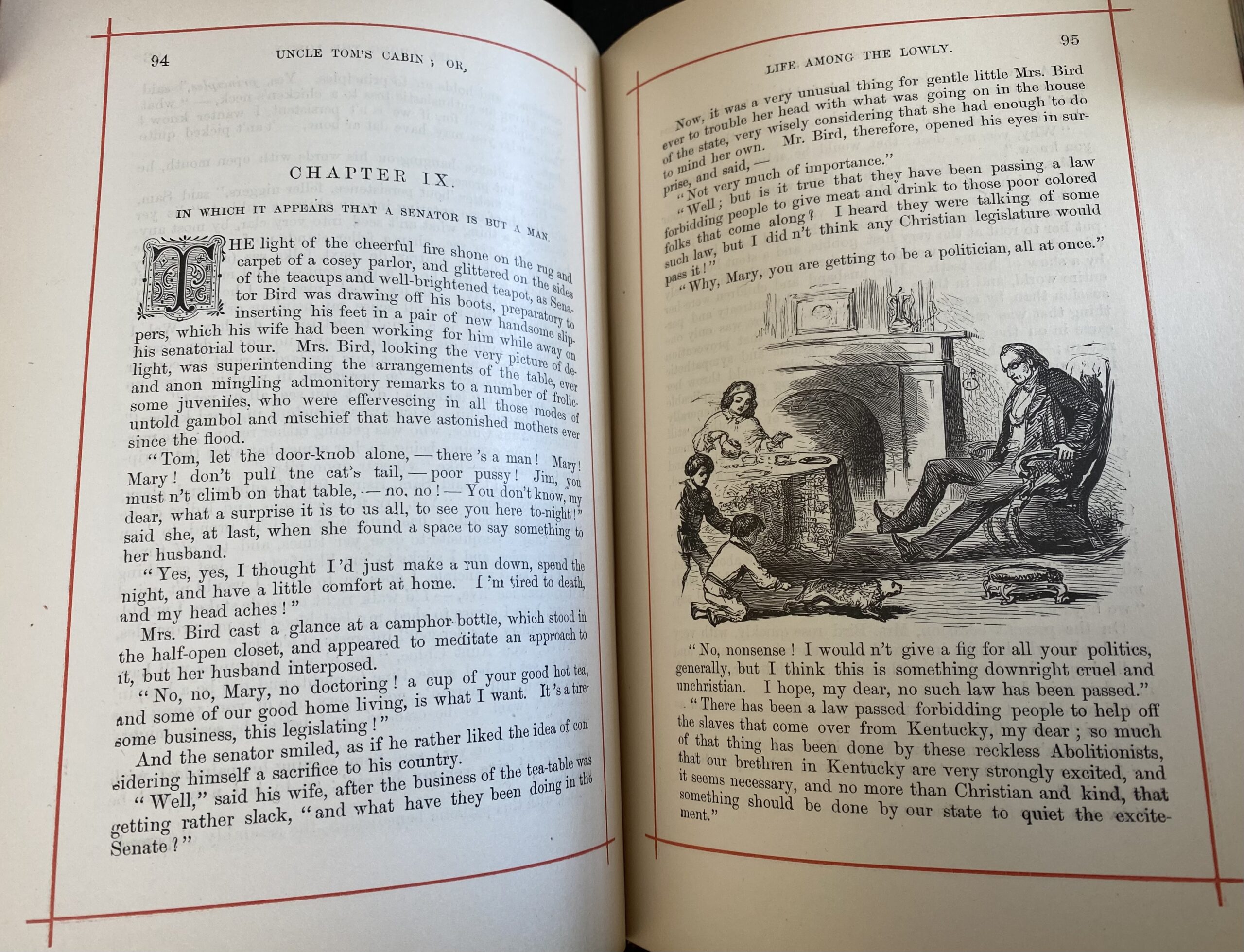
In this moment in our country's history, I am reminded of Chapter 9 of Uncle Tom's Cabin, entitled In Which It Appears that a Senator Is but a Man.
Senator Bird, a member of the Ohio State Senate, has returned home to his wife after voting for a law forbidding the assistance of self-liberated enslaved people, a fictional bill Stowe based on the existing Fugitive Slave Law of 1850.
Mrs. Bird, ashamed of her husband's support for the legislation, engages him in a fierce debate: "It's a shameful, wicked, abominable law, and I'll break it, for one, the first time I get the chance; and I hope I shall have a chance, I do!"
Her chance presents itself in a timely manner. In the middle of their argument, Eliza, an enslaved mother who has just forged the icy Ohio River to save her child Harry from being sold away, arrives on their doorstep with her son.
The Senator and his wife, now face to face with a reality of enslavement rather than an imagined one, welcome Eliza and Harry into their home, give them resources, and bring them to a safe house.
For Senator Bird, Stowe writes, "…his idea of a fugitive was only an idea of the letters that spell the word…The magic of the real presence of distress—the imploring human eye, the frail, trembling human hand, the despairing appeal of helpless agony,—these he had never tried. He had never thought that a fugitive might be a hapless mother, a defenseless child…"
Stowe then directly addresses supporters of enslavement and the Fugitive Slave Law: "Is it fair for you to expect of us services which your own brave, honorable heart would not allow you to render, were you in our place?"
As the Director of Development at the Stowe Center, I have the pleasure of working with our remarkable donors. Friends of the Stowe Center believe in hope and freedom. Their generosity honors the legacy of Stowe—amplifying voices of truth, courage, and conscience.
During their debate, Mrs. Bird says to her husband: "There's a way you political folks have of coming round and round a plain right thing; and you don't believe in it yourselves, when it comes to practice."
It is here that Stowe calls out the hypocrisy of political leaders. How could the Senator support a law that he could not bear to follow in the face of human suffering?
Friends of Stowe: What do you believe is the "plain right thing"?
Write to your congresspeople and tell them today.