

H.B. Stowe to C. Kidder, February 11, 1844
On February 11, 1843, Harriet Beecher Stowe wrote Catherine Kidder about the death of Catherine’s brother, Samuel. This was not the official death announcement, one of the attending doctors wrote previously to another of Catherine’s brothers with the sad news. This was a letter from a sister, a mother, a daughter, a woman who felt intense family connections, written to another woman mourning the loss of her brother. It is a poignant letter and Harriet writes “If I am very minute, and record many little things, it is because this is all I can give you…” The letter is oddly tender in its gruesome details of the prolonged illness and death of Samuel.
Samuel Kidder was a student at Lane Seminary, where Stowe’s father, Lyman, was president and Stowe’s husband, Calvin, taught. Samuel, aged 26, took ill and Harriet and Calvin Stowe took him in to nurse him back to health, expecting a full recovery within a matter of days. Sadly, Samuel lived for 15 excruciating weeks, under the constant watch of the Stowe family, other Lane Seminary students, and two doctors, succumbing to his illness in February. Over the course of 17 hand-written pages, Harriet captures Samuel’s decline, every sore and wound, every indignity of illness, every act of care, the moments of Samuel’s tender acceptance, every futile attempt at comfort.
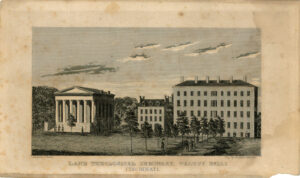
Lane Seminary, circa 1838
For women especially during the 19th-Century, the act of caring during illness was central to their roles as care-takers and central to many women’s domestic identity. Because illness was usually treated at home and attended by untrained family members, caring for the ill was as much about being with the person to offer comfort and companionship as it was medical interventions.
Catherine was not with her brother during this time, and I believe Harriet understood the anguish this may cause her, missing this act of witnessing. And so Harriet served as witness for her, this was “all I can give you.”
Perhaps Harriet hoped that Catherine would feel a sense of fulfilling her responsibility of witnessing through this letter, that Harriet could return that role to her. If so, we see how Harriet’s care for Samuel extended to caring for those around him, particularly the women around him. Perhaps Harriet also wanted to assure Catherine that her brother had not been alone, that there were many people who served as caretaker in her place.
Five months later, Harriet’s own brother, George Beecher, would die at the age of 34, also a tragic death. Harriet’s sister, Catharine Beecher, was visiting George at the time. Harriet’s letter to George’s widow, Sarah, and her sister, Catherine Beecher, is filled with love, visions of their mother’s welcoming George into the afterlife, and passages from The Bible. Toward the end of her letter, Harriet asks her sister Catharine to write and “tell us all about the last evening you spent with George—what he said and did—and every little thing that you can gather up.” Harriet asks Catharine to serve as witness for her.
Perhaps in the act of witnessing, these women were attempting to make sense of tragedy or to cultivate a sense of closeness with the other person, to share their pain and lighten their burden in some way. I believe many of us are still compelled to be with our loved ones in difficult times, to witness their hardship with them as an act of comfort. It’s moments like this that I feel a sense of connection with people who lived very different lives and under very different circumstances than me, and I am left wondering if there are certain universal experiences.