

The abolitionist Frederick Douglass never knew his true birthday.
Growing up as an enslaved child in Talbot County, Maryland, Douglass never saw a formal record of his birth. He also endured forced separation from his mother, Harriet Bailey, who was commanded by her enslaver to labor on farms around the rural county. Though few records survive about Harriet Bailey, who died when Douglass was very young, we know that she would travel long distances in the dead of night just to see and hold her children.
As an adult, after liberating himself, Frederick Douglass chose his own birthday. He selected February 14th, Valentine’s Day, in honor of his mother, whose special nickname for him was her “Little Valentine.”
It’s a tremendously moving story, and a widely shared anecdote about Frederick Douglass’s life. Douglass, denied a beginning to his own story, chooses his own beginning, and in doing so, pays tribute to the love and courage of his mother.
It’s a story we tell at the Stowe Center on our Inheriting Freedom tour, an experience that explores the lives of both Frederick Douglass and the anti-slavery author Harriet Beecher Stowe.
It’s also a story that Douglass himself didn’t tell, and that isn’t (yet) corroborated by primary sources. Why then, does the Stowe Center feel comfortable sharing this story with the hundreds of children who come through the doors of our museum each year?
The answer has to do with trust in other sources: trust in the work of Black historians, and trust in the value of Black oral history and community storytelling.
Douglass and His Chosen Birthday
Douglass doesn’t write about choosing his own birthday in any of his three autobiographies, but he does discuss the psychic pain of being deprived of a birthday.
In Narrative of the Life of Frederick Douglass (1845) he calls the absence: “a source of unhappiness to me even during childhood.” In My Bondage and My Freedom (1855) he says: “This destitution was among my earliest troubles.” In Life and Times of Frederick Douglass (1881), written in his early sixties (though he wasn’t sure when in his early sixties), it remained, “a serious trouble to me, not to know when was my birthday.”
Primary sources also tell us that he chose Valentine’s Day to fill this void. In a diary entry dated Monday, February 14, 1887 Douglass says:
If right in my estimate of the length of time I have been in the world, I am now 70 years old. Aside from a cold and a little hint of sea sickness, I am quite well strong and cheerful.
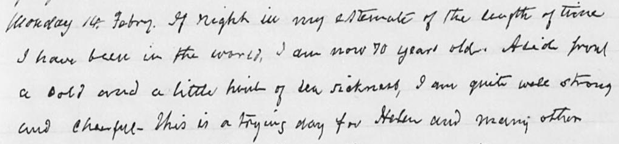
Frederick Douglass Diary, 1886-1894, courtesy Library of Congress.
The brief reference makes it clear that by the final decades of his life, Douglass was officially using February 14, to “estimate” the length of his life.
Secondary Sources
It is then the 20th-century Black historian, Dr. Benjamin Quarles, who provides a source for the Valentine nickname story. In his landmark 1948 biography of Douglass, Quarles has a brief explanatory footnote about the February 14th diary entry. Quarles simply says, “Douglass selected February 14 as his birthday because his mother had called him her ‘Valentine’” (Quarles 311).
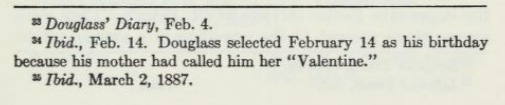
A footnote from 1968 edition of Benjamin Quarles’s biography of Douglass.
Quarles provides no citation or source explaining the origin of the narrative, he simply states it as matter-of-fact common knowledge (much as one might state that Frederick Douglass was born in Maryland, or that he was a prominent 19th-century abolitionist).
Quarles could have been restating an apocryphal anecdote, of course, though that seems unlikely for a conscientious historian. We must also consider that Quarles was deeply engaged not only with archival material about Douglass, but with Black communities for whom Douglass’s life was within living memory. Within these communities, oral storytelling about Douglass’s life was an important mode of historical record-keeping, a means of keeping the legacy of a father, grandfather, and freedom builder alive.
Black Community and Historical Memory
It was Black community members in Douglass’s late-life home of Washington, D.C. that cemented Valentine’s Day as a Douglass memorial. The Washington Post captures one such celebration, held on February 13, 1897, only two years after Douglass’s death, and explains the memorial’s chosen date:
Frederick Douglass, whose memory the colored people continually honor, never had a birthday that he could call his own. In consequence of having been born a slave, when no record of births was kept. In this dilemma, he selected St. Valentine’s Day, February 14, as his natal day. (The Washington Post, February 13, 1897, page 9)
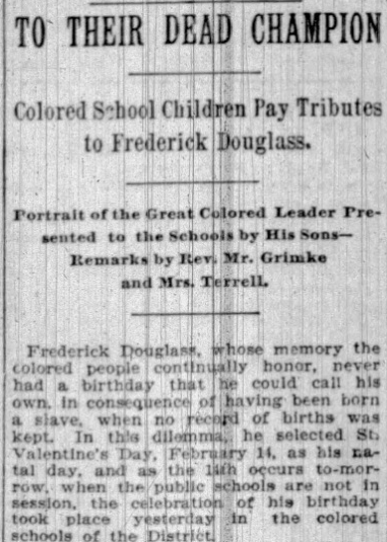
The Washington Post, February 13, 1897, page 9.
The account once again affirms Douglass’s choice of Valentine’s Day as his birthday, though no specific source or speech is cited, implying this was widely shared knowledge among attendees.
These memorial efforts were amplified by the activist Mary Church Terrell, a personal friend of Douglass. In February of 1897, only days after the celebration mentioned above, Terrell successfully campaigned to have February 14th recognized as “Douglass Day” in Washington D.C.’s Black schools, believing that teaching Black history would empower future generations of Black children by encouraging “self-respect and pride” (Terrell 134). Terrell would continue to organize and speak at Douglass birthday memorials through the end of her life, sharing his significance and achievement alongside descendants and loved ones.
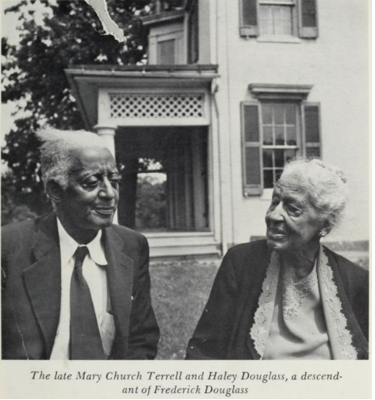
Mary Church Terrell and Haley Douglass, from Terrell’s memoir, A Colored Woman in a White World.
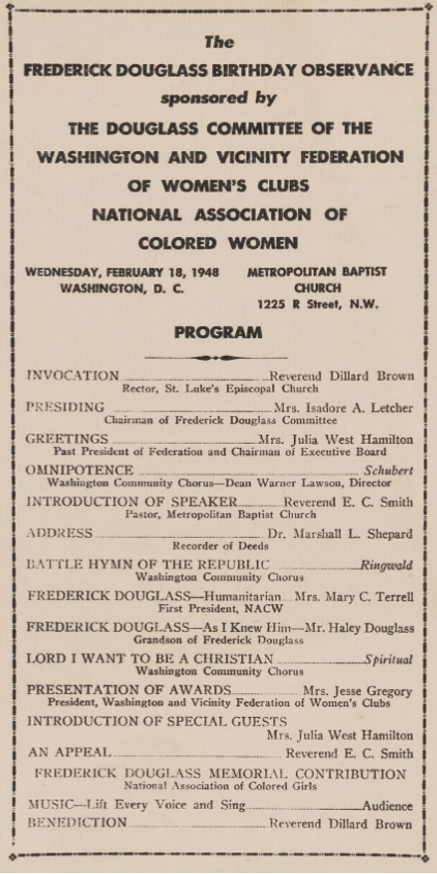
1948 Program for a Frederick Douglass Birthday observance where both Terrell and Haley Douglass are listed as speakers. Courtesy Anacostia Community Museum Archives.
In addition to archival sources, these are the human sources that anchored Quarles’s work: Douglass’s friends and descendants, the Anacostia neighborhood of Washington D.C. where Douglass and his family made a home, and the Frederick Douglass Memorial and Historical Association, which preserved that home and his vast collection of manuscripts and correspondence.
Furthermore, while we may not have an example of Douglass stating outright that he chose his birthday because his mother called him her Valentine, we do have a striking account of a gift Harriet Bailey bestowed on him that evokes the holiday. In My Bondage and My Freedom, Douglass recalls a night where he nearly went to bed hungry and despairing, when his mother arrived on a rare late-night visit. She not only held and comforted him, but fed him with a large ginger cake:
That night I learned the fact, that I was, not only a child, but somebody’s child. The “sweet cake” my mother gave me was in the shape of a heart, with a rich, dark ring glazed upon the edge of it. I was victorious, and well off for the moment; prouder, on my mother’s knee, than a king upon his throne. (My Bondage and My Freedom, “Chapter III: Parentage)
According to records uncovered by the historian and journalist Dickson Preston and shared in his 1980 biography, Young Frederick Douglass: The Maryland Years, Douglass was, in fact, born in February of 1818. Though Douglass himself never had this fact corroborated by written records, the striking implication that Harriet Bailey’s appearance may have been a birthday visit, and the cake a special birthday gift, adds an additional poignancy to Douglass’s memory.
Benjamin Quarles’s assertion that Douglass was his mother’s Valentine is a secondary source, to be sure. But the Stowe Center recognizes oral history as a valid and vital source of community knowledge about the past, particularly among marginalized communities who have been systematically denied more formal mechanisms of remembrance. We also prize the work of historians who immerse themselves in the communities who safeguard vital stories of the past.
By connecting this constellation of sources, we see a larger picture—a beating heart, the effort of a man to honor a mother’s love, a Valentine sent from the past to all of us.
“Inheriting Freedom” is offered monthly during the summer as an intergenerational family tour. It is also available as a school field trip, or a private booking for families, youth groups, and more! If you would like to inquire about booking “Inheriting Freedom,” please contact our Visitor Experience Coordinator, Yateena Young, YYoung@StoweCenter.Org.
Douglass, Frederick (1855). My Bondage and My Freedom. Urbana, Illinois: Project Gutenberg. Retrieved January 29, 2026.
Preston, Dickson J. Young Frederick Douglass. JHU Press, 1985.
Quarles, Benjamin. Frederick Douglass. New York: Atheneum. 1968.
Terrell, Mary Church. A Colored Woman in a White World. New York: G.K. Hall. 1996.