
Working in archives, I come across so many items that spark curiosity. Sadly, there isn’t enough time to follow every lead to its fullest research. But there are some items that just keep coming back to my mind. One of these is a series of signatures that are part of the The Affectionate and Christian Address of Many Thousands of Women of Great Britain and Ireland to their Sisters the Women of the United States of America. The Address, as we call it, documents British women’s support of abolition and anti-slavery efforts in the United States and encouraged American women to reject slavery as un-Christian, as an abomination against God’s creations, and as destructive to the sanctity of families.
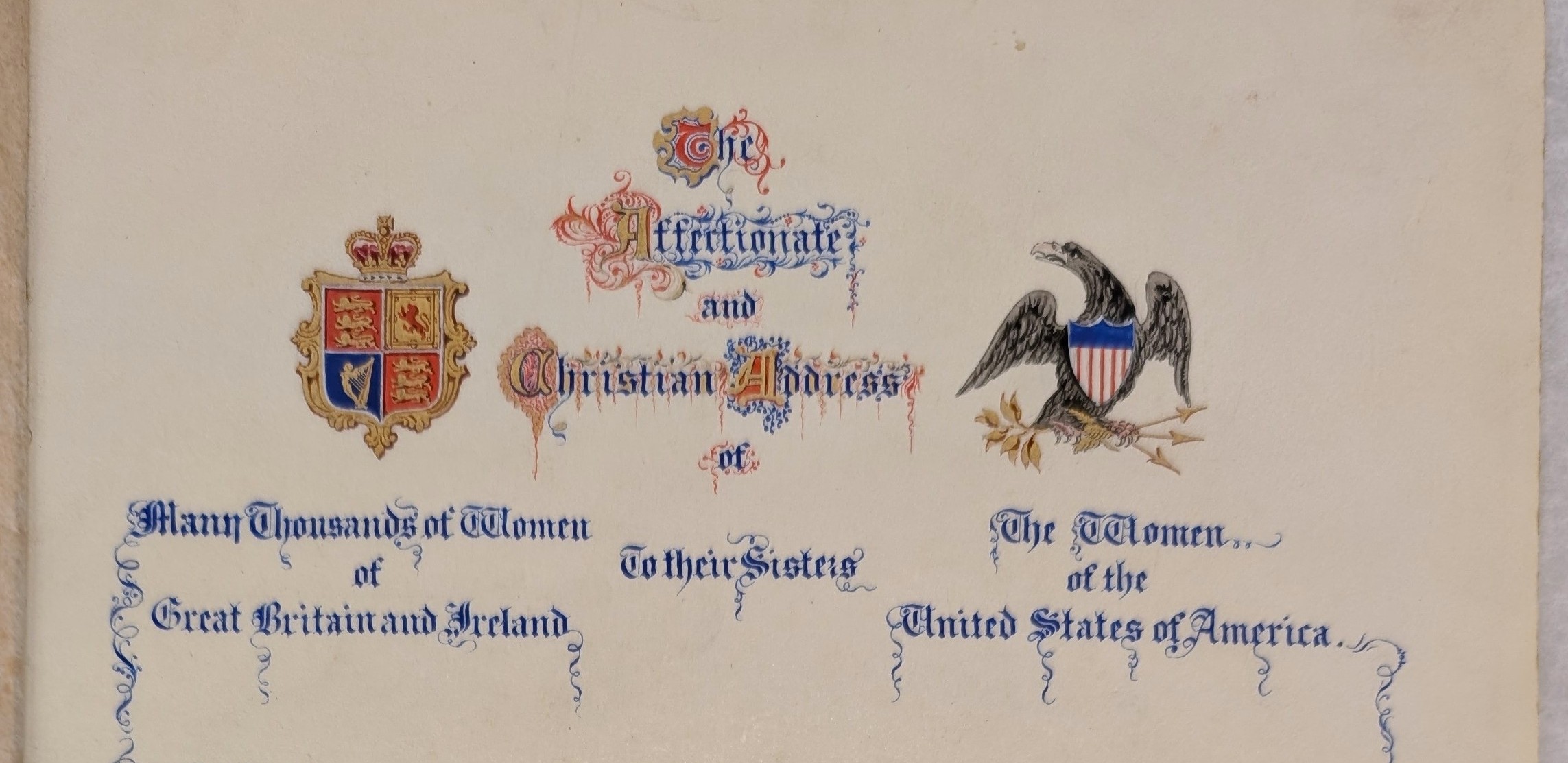
Photo: The Address, Detail
During the 17th, 18th, and into the 19th centuries, Britain dominated the transatlantic slave trade, kidnapping and transporting an estimated 3.1 million people from Africa to British colonies in the Americas. On March 25, 1807, the Abolition of the Slave Trade Act was passed, formally ending this trade in human lives for Great Britain. Slavery in Great Britian and British colonies remained legal until it was abolished there in 1834. Yet so deeply was slavery built into the economic and social systems of Great Britain that slavery’s direct legacies and informal structures continued for many years.[i] The abolition of slavery in Great Britian inspired the women of Great Britain to urge the women of the U.S. to work for the same.
In 1853, following the international success of Uncle Tom’s Cabin, Harriet Beecher Stowe toured Great Britain with her husband, Calvin Stowe, her brother, Charles Beecher, her sister-in-law, Sarah Buckingham Beecher, her nephew, George Buckingham Beecher, and Sarah’s brother, William Buckingham.
On this tour, Stowe received many gifts from people and groups who wanted to recognize her anti-slavery efforts or to support abolitionist work. Three of the most prominent items she received were a gold bracelet; an extravagant silver and crystal ink stand; and The Address of support signed by over 500,000 British and Irish women, bound in 26 volumes. If you’ve ever wondered what half a million signatures look like, I can tell that it is impressive.
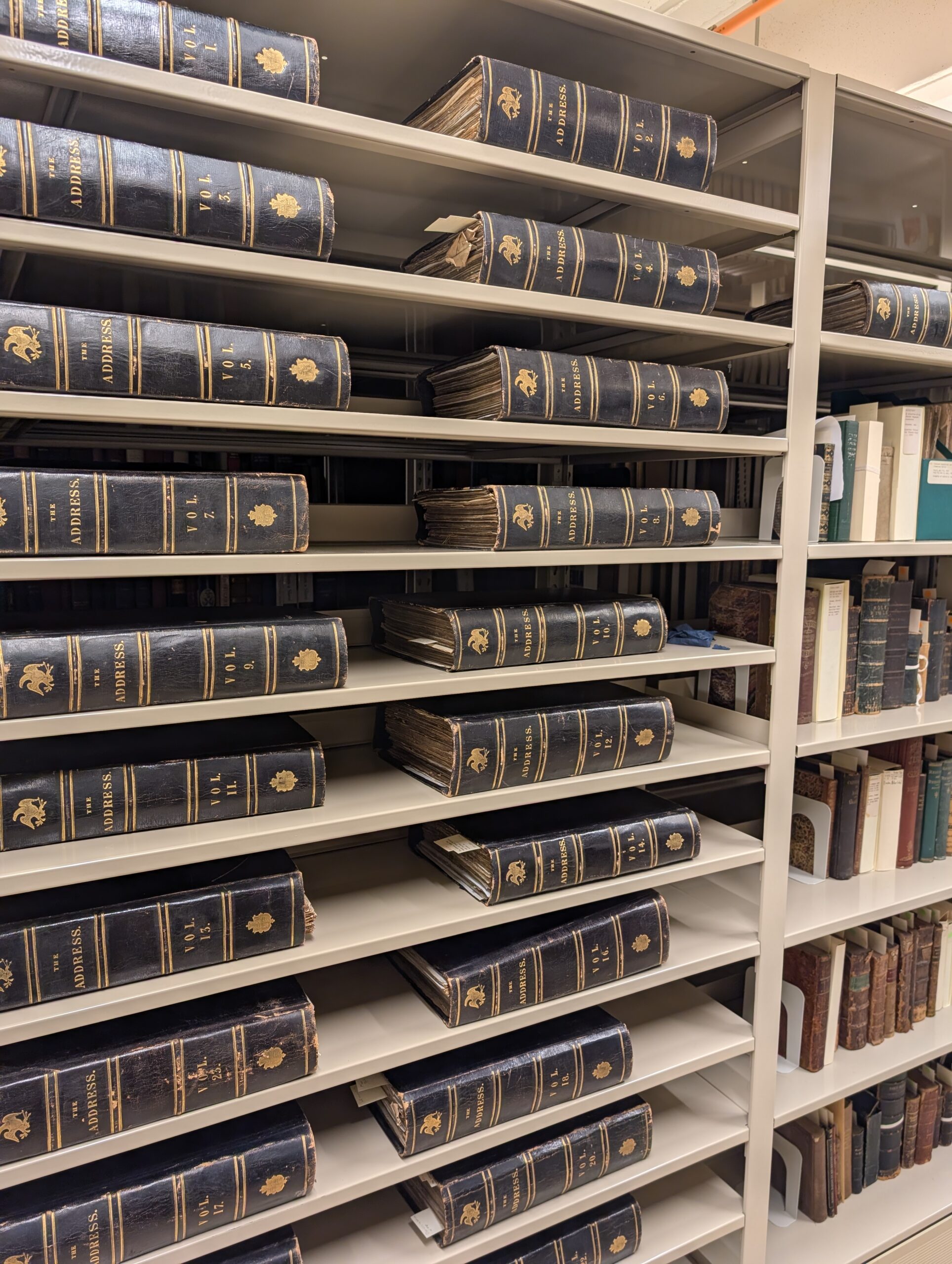
Photo: The Address
Volume I of The Address contains the address, elegantly scripted on vellum and “illuminated” with gilded, red, and blue illustration. The rest of the volumes contain the signatures. Each line collects the signature of the woman, the “Name, or Profession, or Occupation of Husband or Father,” and place of residence.
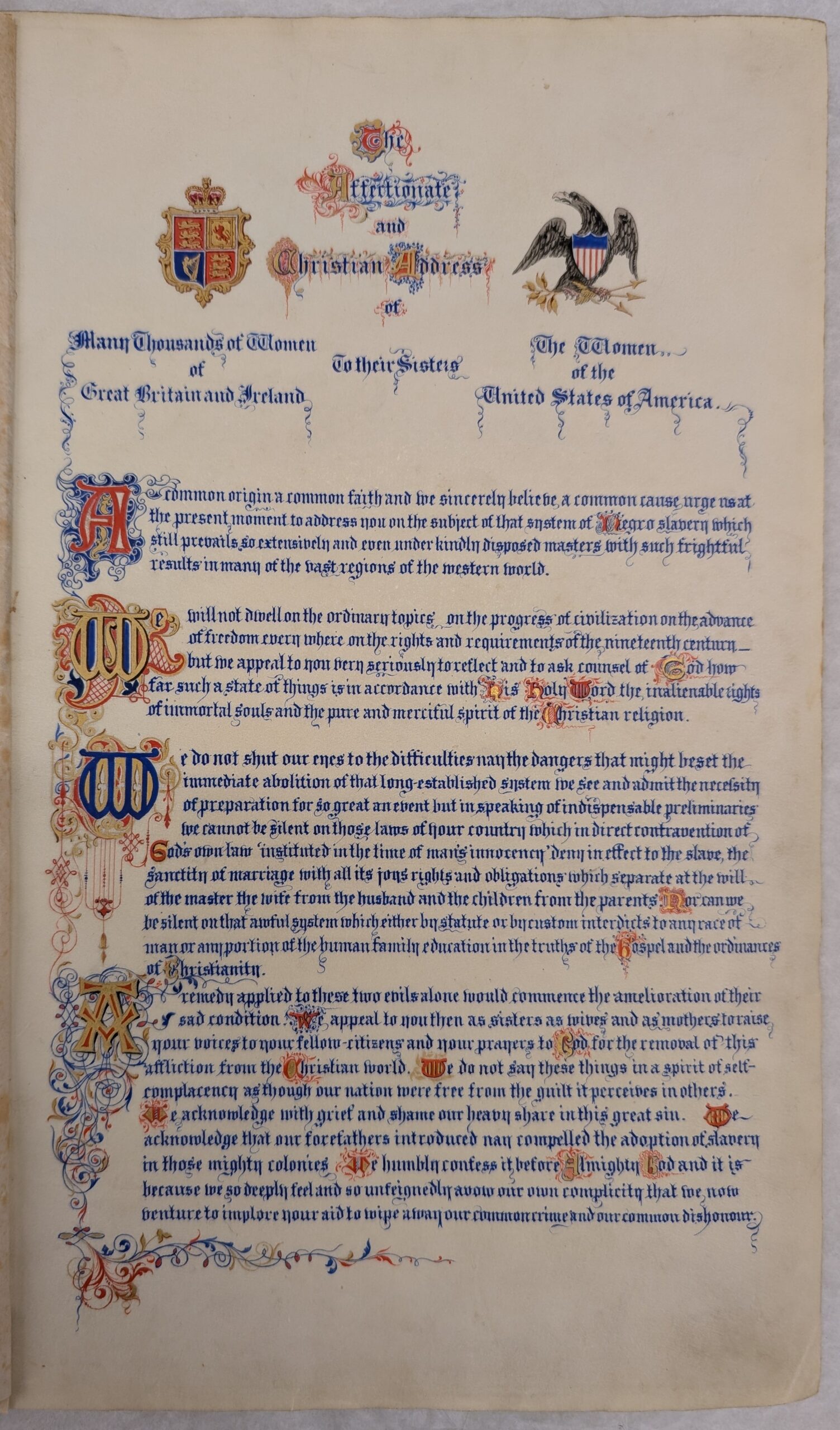
Photo: The Address, First Page
I have so many questions about The Address. Who collected the signatures? How did they collect the signatures? Are there other similar addresses? How does this fit into the practice of 19th century petitioning? Were there clearly recognized differences between a petition and an address? How did the women who signed this Address understand the document and its purpose?
From the documented information, the volumes represent a great diversity of social standing. There are signatures of titled aristocracy, farmers, housewives, and nearly every other social position women held. There is one series of signatures, though, that I keep going back to: the women incarcerated at Lincoln Penitentiary.
I believe this is the Penitentiary at Lincoln Castle, which operated the prison from 1847-1878, though the castle housed a jail for people awaiting court appearances or transportation before this time. The prison housed men and women in separate wings as well as children as young as 8 years old. Crimes ranged from stealing or destroying books to robbery and murder. Seven people were executed during the prison’s operation. Lincoln Penitentiary was structured as a “segregating system” in which inmates were kept isolated in individual cells. The people in charge of the prison isolated the inmates in this way to protect them from the so-called “negative influences” of other inmates. Aside from brief periods for exercise and to attend chapel, inmates were confined to their cells.[ii]
The women from Lincoln Penitentiary who signed The Address include 21 inmates, the matron, and the submatron.
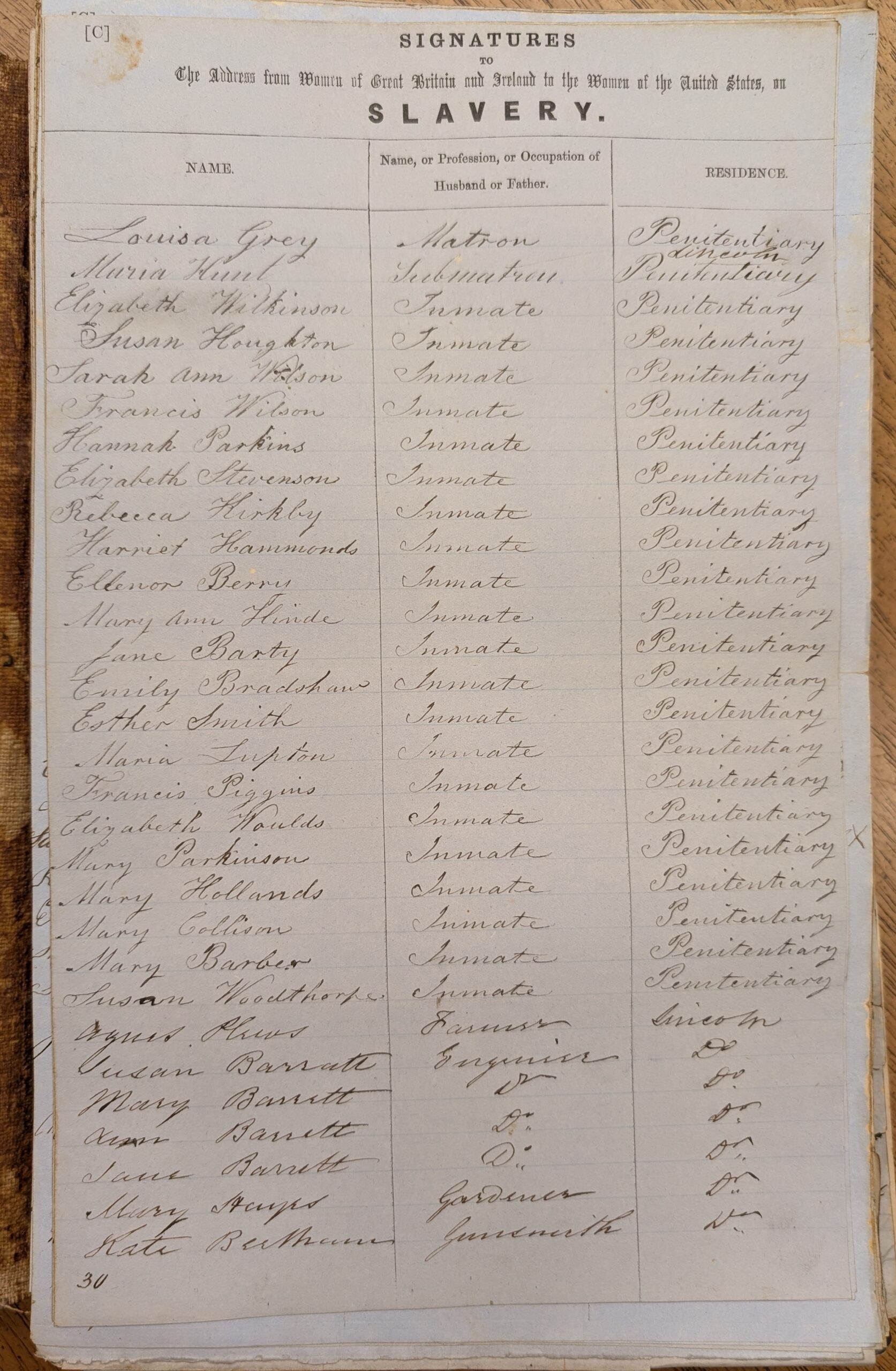
Photo: Lincoln Penitentiary; also information transcribed (see below)
Immediately I want to know more about the women included in The Address; Who were they? Where did they live? Did they have families? Were there additional incarcerated women not represented in The Address? Even a passing familiarity with a Charles Dickens novel tells us of the injustice of the 19th-century British penal system, and so I want to know more about the circumstances around their imprisonment.
And how did their names come to be included on this address; both the incarcerated women and the matron and sub-matron, for we have to wonder at people working for the penal system and signing against the system of slavery.
We see from the handwriting that, unlike the individual signatures elsewhere, these names were all written by one person. So, how much agency did these women have in the decision to add their names? I often consider two possibilities for this (though undoubtedly there are many more). It is possible that the matron or sub-matron supported signing The Address and then added the women’s names as people she could speak for. In this scenario, the women had little agency, and their names were added by the women in positions of authority over them.
Another possibility, and frankly the one that I hope is the case, but which is likely a very optimistic situation for the Victorian penal system, is that the incarcerated women actively chose to add their names. In my optimism, I imagine a trans-national feeling of understanding among oppressed groups.
While it is unlikely that these incarcerated women were given a choice in this matter of adding their names to The Address, there was a growing social awareness in the 19th-century that crossed geographic and socio-economic borders thanks in part to popular writers such as Harriet Beecher Stowe, Charles Dickens, Victor Hugo, and the like; wider distribution of newspapers, magazines, and books; and increasing literacy rates. I am confident that at least some of these incarcerated women were aware of slavery in the U.S. and had opinions about it. Perhaps they, as incarcerated women, would have felt a shared empathy with other deeply oppressed women.
Clearly, I have so many more questions than anything else at this point. Diligent research will be able to answer some questions and afford a deeper understanding of who these women were. And of course, diligent research will inevitably raise even more questions. There are other questions we may not be able to answer decidedly one way or another. Getting to the interiority of anyone from history is notoriously challenging. What people felt, how they understood a situation, how their personal experiences informed their thoughts, these are slippery questions to ask ourselves today, to say nothing of asking them of someone who lived almost 175 years ago. But there is value in asking these questions, in thinking about how we may answer them, in considering the human experience of people 175 years ago, and in living with the unknown and unknowable.
Names on The Address:
Name; Occupation; Residence
Louisa Grey; Matron; Lincoln Penitentiary
Maria Hunt; Submatron; Lincoln Penitentiary
Elizabeth Wilkinson; Inmate; Penitentiary
Susan Houghton; Inmate: Penitentiary
Sarah Ann Wilson; Inmate; Penitentiary
Francis Wilson; Inmate; Penitentiary
Hannah Parkins; Inmate; Penitentiary
Elizabeth Stevenson; Inmate; Penitentiary
Rebecca Kirkby; Inmate; Penitentiary
Harriet Hammonds; Inmate; Penitentiary
Ellenor Berry; Inmate; Penitentiary
Mary Ann Hinde; Inmate; Penitentiary
Jane Barty; Inmate; Penitentiary
Emily Bradshaw; Inmate; Penitentiary
Esther Smith; Inmate; Penitentiary
Maria Lupton; Inmate; Penitentiary
Francis Piggins; Inmate; Penitentiary
Elizabeth Woulds; Inmate; Penitentiary
Mary Parkinson; Inmate; Penitentiary
Mary Hollands; Inmate; Penitentiary
Mary Collinson; Inmate; Penitentiary
Mary Barber; Inmate; Penitentiary
Susan Woodthorpe; Inmate; Penitentiary
[i] U.K. Parliament, “The Transatlantic Slave Trade,” https://heritagecollections.parliament.uk/stories/the-transatlantic-slave-trade/ accessed 5/14/2026.
The National Archives, “Slavery and the British Transatlantic Slave Trade,” https://www.nationalarchives.gov.uk/help-with-your-research/research-guides/british-transatlantic-slave-trade-records/ accessed 5/14/2026.
[ii] Prison History, “Lincoln Castle Prison,” https://www.prisonhistory.org/2020/04/lincoln-castle-prison/ accessed 5/14/2026
Lincoln Castle, “Victorian Prison,” https://www.lincolncastle.com/explore/victorian-prison accessed 5/14/2026