
Through my work, I seek to express the courage and heroic stature of activist women while reflecting our ongoing pursuit of representation and equality.–Brenda Councill, artist
Life-size statues of women represent roughly 4-8% of full-size sculptures in the Unites States. The new statue of Harriet Beecher Stowe now gracing our campus is only the second full-size statues of Stowe in the world—the first resides in the Walter Jones Historical Park, beside the Mandarin Historical Society in Florida, where Stowe spent many winter months and helped establish a school for Black children.
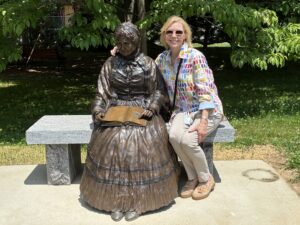
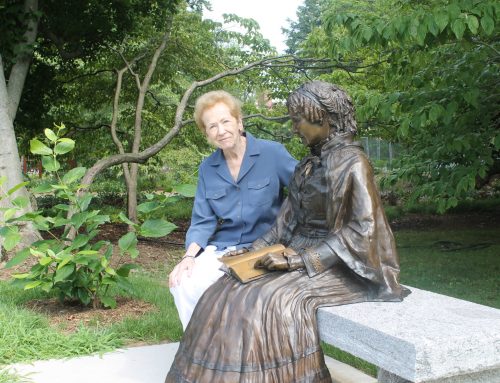
Brenda Councill June 2026 with Harriet Beecher Stowe statue she sculpted.
Brenda Councill, the renowned artist who sculpted this tribute to Stowe, is certainly increasing the number of statues of women in the United States.
Councill was selected by The Ohio Women’s Memorial Commission to create a Women’s Commemorative Monument on the Ohio Statehouse grounds and should be installed late this year. The Ohio Women’s Monument honors the enduring contributions of women who have worked—and continue to work—for a better world through education, employment, civic engagement, and beyond. A project of the Ohio Women’s Suffrage Commission, the Capitol Square Review and Advisory Board, and the Capitol Square Foundation, the monument reflects a deep commitment to recognizing women’s leadership and legacy.
Councill’s Florida life-size bronze, commissioned by the City of Jacksonville, and fiscally sponsored by the Mandarin Museum & Historical Society, “Harriet Beecher Stowe in Mandarin,” was installed in 2024 alongside the Mandarin Museum and the 1898 St. Joseph’s Mission Schoolhouse for African American Children. The statue depicts Stowe teaching two children how to read, illustrating her dedication to education.
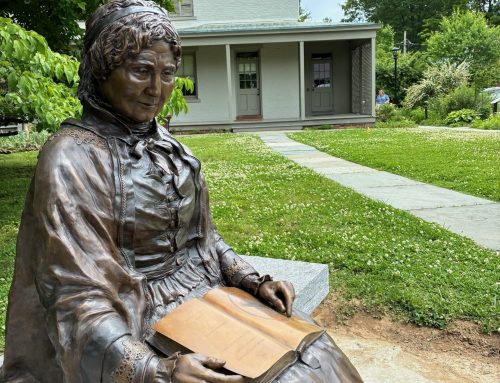
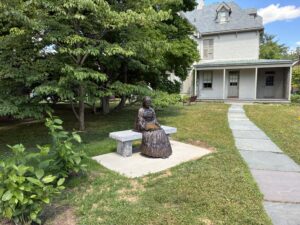 The statue of Stowe installed at the Stowe Center June 12, 2026, depicts the author reading a freedom narrative by Josiah Henson, one of the real-life people who inspired the fictional character of Tom in Uncle Tom’s Cabin. This statue is the gift of Stowe’s great great granddaughter Rosamond Warren Allen, who also helped fund the Mandarin original.
For the dedication Allen said: “It is my hope that this statue of Harriet Beecher Stowe in her own ‘backyard’ will help each of us visualize what a difference one individual can make by taking action when they see the wrongs of the world and help to make them right! Let us all commit to doing what we can do to right the wrongs of our day!!”
Councill affirms her hope to increase representation of women who make a difference: “I seek commissions that center women because public art can draw visitors into a space, honor memory, and invite active engagement. Through my work, I seek to express the courage and heroic stature of activist women while reflecting our ongoing pursuit of representation and equality. By prompting this engagement, sculpture invites viewers to reconsider societal expectations and recognize women’s evolving roles as political leaders, innovators, and agents of change.”
Statues of real women (as opposed to mythical figures) in the United States are increasing, though they still lag in comparison to men; of the 5000 full size statues in the US, only 300 depict women.
In 2016, the Smithsonian wrote about the lack of women statues and praised the activism of Where Are the Women?, a campaign to increase the number of statues to real women in NYC. “While one campaign isn’t enough to solve persistent issues of gender discrimination and inequality in the U.S., by pressing to honor real women from history, cities around the country can restore them to a story that has ignored them for so long.”
Where Are the Women? was led by New York City Girl Scout Troop 3484 (Go girls!) and supported by the Monumental Women organization. Although Where Are the Women? is no longer active, having achieve their goal of adding more women to the Central Park monuments, Monumental Women is still very much active. Currently Monumental Women is striving to amplify the work of Augusta Savage, who, among many other incredible sculptural pieces, created a remarkable sculpture called Lift Every Voice and Sing for the 1939 World’s Fair held in Queens, New York. Because she did not have the financial resources to transport or store this clay sculpture let alone cast in in bronze, it was destroyed. “That is emblematic of the erasure of African American artists, African American culture,” said Denise Murrell, the Tisch Curator at the Metropolitan Museum of Art.
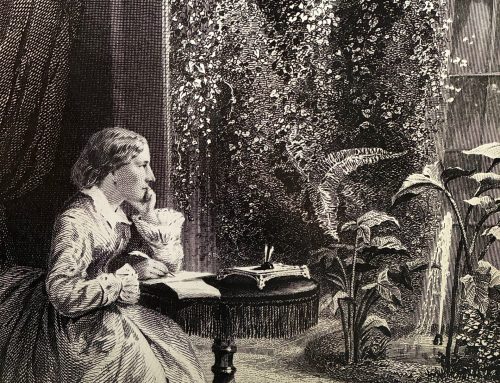
The Stowe Center is overjoyed to welcome the statue of Stowe reading to her home. Some folks have asked, “Why is she not reading Uncle Tom’s Cabin?” Our answer is simple: Stowe is depicted in what we consider a power pose: reading one of the hundreds of books she read in order to inform herself about the real lives of the people she would depict in fiction. By reading, Stowe exemplifies one of the most powerful ways we learn empathy and inspire action for the good of all.
Of interest: