
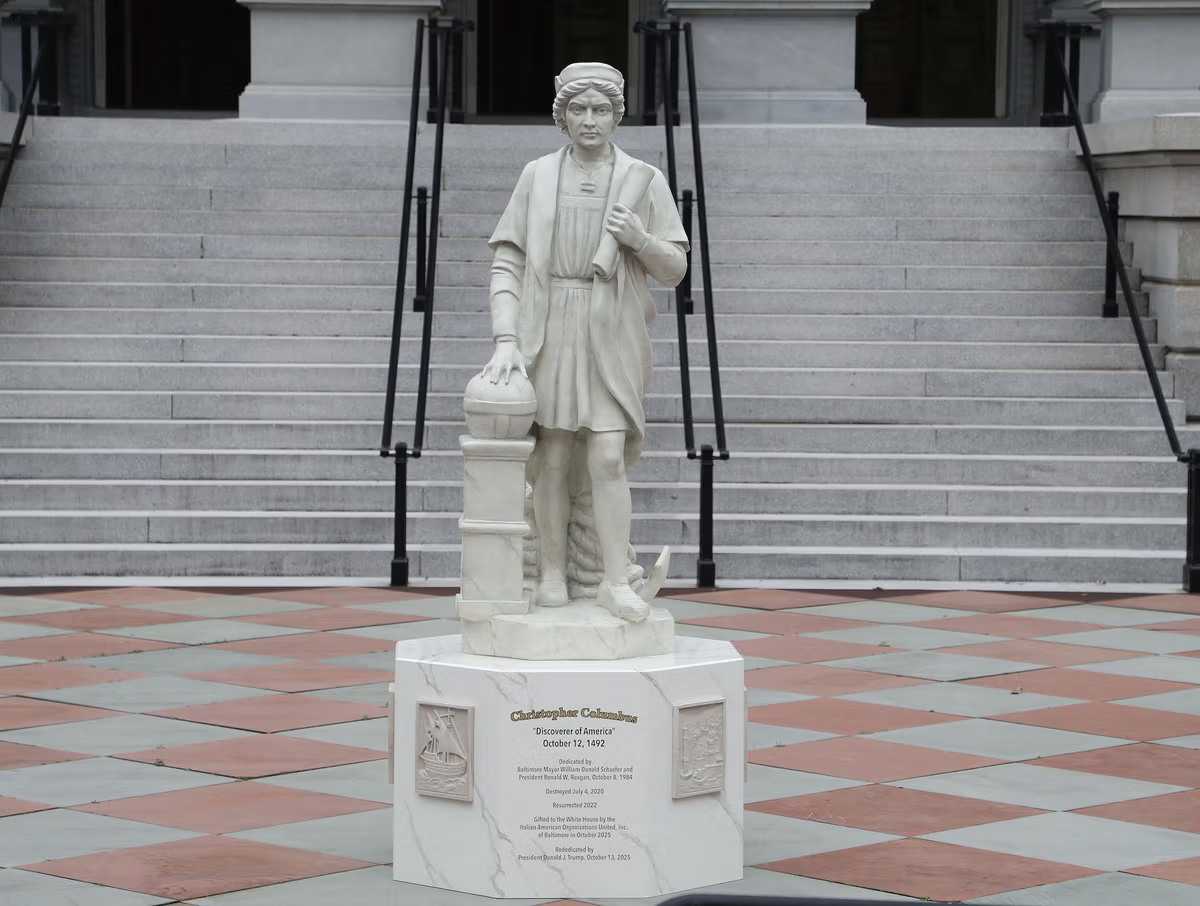
A statue of Christopher Columbus was just installed on White House grounds. If that fact alone doesn’t bother you, please keep reading.
I came to work at the Stowe Center in the summer of 2017, only a few weeks before white supremacists, carrying torches and shouting hate, rallied in Charlottesville, Virginia. They gathered in protest around a statue of Confederate General Robert E. Lee that the city was planning to remove. Conversations about public statues have often been initiated by visitors at the Stowe Center since then, as our tours here continually challenge us all to consider: how do we remember? Who do we remember? And what does it say about where we are as a nation right now?
Frequently, folks from across the political spectrum have suggested that statues in public places have something to do with history. They often couple this observation with an assertion that history should be preserved.
But statues are not historical in the way that letters and personal artifacts are. Purposefully erected in public spaces, they are intentional objects that shape how history meets the present. They honor the person depicted and imply that their lives are worthy of collective remembrance. In fact, the Stowe Center offers a Stowe on the Go mobile program about statuary and other monuments called When We Don’t See the Signs—Columbus features prominently in it.
When activists demand the removal of a public statue, then, they are refusing the idea that the person depicted should be remembered in a way that implies both honor and literal space in civic memory. Robert E. Lee, for example, was an enslaver and white supremacist who led a treasonous army to fight for slavery’s continued existence. Statues all over the country were erected to honor and remember him for exactly this. When town, city, state, or national officials choose to leave a Lee statue standing, they send a message that they value Lee as an enslaver, white supremacist, and traitor—and they do it without having to ever open their mouths. It’s just history, they say facetiously. They know, and we know, that it is more than history: it is public memory acting on the here and now; it is not just the statue, but the ideas represented by the statue.
Columbus statues make this especially clear because they do not represent a historical figure exactly. Of course, there was a historical man with that name who made four sea voyages to the Western hemisphere. Of course, that real man probably was born in Genoa, in present-day Italy. But why honor him with a statue? What memories of Columbus are these statues meant to evoke?
One idea memorialized by the statues is that Columbus “discovered” “America” through his four transatlantic voyages. This legend of Columbus as a daring explorer has been woven into some of the earliest stories of U.S. national origins, stories that intentionally sought out non-British “heroes” as tensions with the crown intensified. So popular was this legend of Columbus that by the time of the American Revolution, the myth took on a body: not as Columbus, but as a quasi-goddess figure, Columbia, named after him. If that name sounds familiar, you are probably hearing one of the many echoes of it still in use today, as in, Columbia University. Columbia Pictures. Columbia Records. Or even the longtime unofficial national anthem, “Hail Columbia.”
That Columbus could be reimagined as a goddess figure tells us right away that his legacy is built on legend, not historical fact. And the facts that we do have, based on careful research and, often, Columbus’s own words, illuminate the many reasons why his life—his true life—is not one that demands honor. He intentionally and brutally worked to destroy the vibrant cultures and traditions of Indigenous peoples, including the Arawak, Taíno, and Carib; his violence, exploitation, and abuse is well-documented, including by him. Is his statue on the White House grounds to remember and honor the specific genocide he perpetuated? Is it to implicitly honor the genocidal violence of all European colonizers of the Americas? If the Columbus statue is a monument to actual history, it is a very ugly history.
But the history of Columbus statues tells us that the myth of the man, and what some folks wanted that myth to represent, was always held to be more important than the truth of his life. Beginning in the late-nineteenth century, as Italian immigrants faced violence and discrimination throughout the U.S., the declaration of Columbus Day, and the memorial statues that followed, were a way to declare that those Italian immigrants belonged here. As Basil Russo, president of the Conference of Presidents of Major Italian American Organizations, notes, “Columbus statues have long stood as symbols of pride and cultural identity for more than 18 million Americans of Italian descent,” and that, “For over a century, Columbus’s legacy helped Italian immigrants navigate prejudice and hardship, serving as a source of unity and belonging as they built new lives in this country.” (https://www.cnn.com/2026/03/22/politics/christopher-columbus-statue-white-house-grounds)
How a symbol makes somebody feel is not unimportant, and neither is the urge to feel welcome and at home in a new place, be it city, town, state, or country. That an image, a story, a statue can evoke that feeling, can offer that sense of welcome, speaks to the power of each. If the story represented by that statue isn’t true, though, what does that say about that feeling of welcome? Worse, when the actual true story represented in the statue is one of violence, genocide, and racism, of horrifying harm against other people, what kind of welcome is really being offered? What is the cost of that feeling of welcome?
For those who want to find welcome in it, a Columbus statue offers fable and sparse fact in place of truth. Columbus never set foot in North America. He was born in the Republic of Genoa, not the country of Italy—because it didn’t exist until 1861. To see it as a sign of belonging is to choose to see it in this way. It is a wish more than a history.
I like truth and sincerity. I understand why someone might prefer a made-up story that makes them feel good to a true story that upsets them. But for me, the appeal of the make-believe, preferring a legend to the truth, can only keep pointing to just how awful that truth is. Attempting to cover it over is also always a confession that there is something terrible to cover over.
And a statue of Columbus declares the hideous history of the man, no matter how much someone insists on the fable, no matter how much someone says it is a celebration of bravery. The statue just erected on the White House grounds is a remade version of another Columbus statue, one that was torn down by protestors in Baltimore in 2020. It was torn down because protesters not only recognized the true, violent, genocidal history in the statue that myth could never quite cover over, but also because they rejected that history being honored in public space.
To put that statue up again, in the nation’s capital, is to embrace and honor that history. And just as insisting on the myth of Columbus can never fully hide the truth of Columbus, leaning on the myth to justify the statue’s presence can never fully hide, can never not honor, the true history of genocide and violence it represents. That history—of brutality, white supremacy, empire, and exploitation—is not incidental to the statue’s presence on the White House grounds; it is the point.