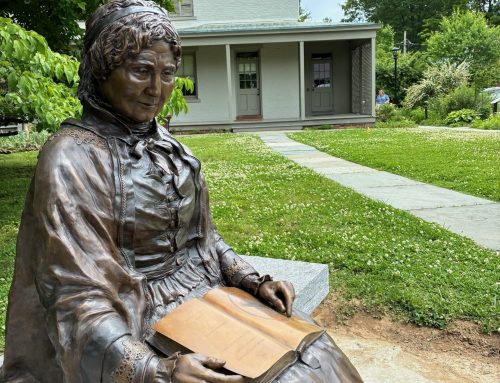

I wonder if Catharine Beecher (1800-1878) would have joined the Tradwife movement.
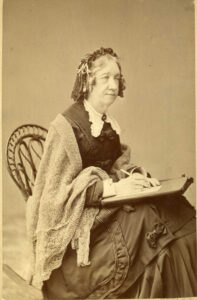 The oldest of the nine Beecher children, Catharine Beecher presumably would have joined the ranks of wives and mothers had her beloved fiancé survived a shipwreck in 1822. In his will, he left her money which she used to start a school for girls and solidify her role as a social influencer of great renown for the 1800s.
Catharine Beecher opened one of the first U.S. academies for girls in Hartford, CT, in 1823, together with her sister Mary Foote Perkins (1805-1900)—later Harriet Beecher (Stowe) would be pulled in to also teach though she resented the time taken from her own studies and writing.
Unlike other girls’ schools (or the tradition of mother-to-daughter learning) that emphasized domestic skills and morality, the Hartford Female Seminary offered intellectual pursuits in mathematics, science, and literature; nutrition, sanitation, and child development. And, although she also was an ardent believer in moral and domestic education, Catharine Beecher felt strongly that girls need to exercise, stretching their bodies as well as their intellects. She employed dumbbells, wands, and rings in a prescribed routine to help keep girls healthy, graceful, and better prepared for the physical rigors of motherhood.
Her reasoning always was that girls must be fit—body, mind, and soul—to raise good children.
Catharine Beecher elevated domesticity to a professional science. She wanted respect for “women’s work.”: “[The] duties of the woman are as sacred and important as any ordained to man.” (The American Woman’s Home: Principles of Domestic Science (1889), p 14)
She did not expect her girls to become working women competing with men for jobs. Instead, as a purveyor of the Cult of Domesticity (also known as the Cult of Real Womanhood), she prepared girls as good mothers and wives—their ordained place. (For more about the complicated nuances of Catharine Beecher’s philosophies and her lived experience, please watch our blog.)
I recently read a review of the satirical thriller Yesteryear: A Novel (2026) by Caro Clair Burk, in which a contemporary Tradwife influencer is transported by to 1855—where she is trapped in the life she purportedly reveled in when she had ready access to running water and lattes.
This piqued my interest because I had been thinking of Catharine Beecher and why she was on a multi-story banner on the Department of Education in Washington, DC this past year. She is alongside Benjamin Franklin, Martin Luther King Jr., Booker T. Washington, Anne Sullivan, and directly next to Charlie Kirk.
The Education Department’s press secretary shared this statement about the banners: “We are proud to honor visionary leaders whose contributions have shaped the future of education for generations.’
Yes, Catharine was a progressive educator for her time, but is she a visionary role model now?
Well—maybe, if you are a Tradwife.
Tradwives believe in “more traditional domestic roles, with a modern understanding. Tradwives hold the view that there is strength, empowerment, and fulfillment in running a household and nurturing family relationships. . . . By nurturing their families, tradwives find spiritual enrichment and purpose, seeing their role as vital architects of their family’s future.” What Trad Wives Believe – TradWife TradLife
MS Magazine addressed Tradwifedom recently: “There is perhaps no better example [of the Tradwife movement] than the 19th century Cult of Domesticity, also known as the Cult of True Womanhood. . . . The movement [that] glorified the true woman who fulfilled her God-given role of wife and mother, serving solely within the sphere of the home.”
Hmm.
Catharine Beecher was a visionary educator in many ways that did help some women—especially middle-class white women—step into the future with greater intellectual and physical preparation. But her vision fell short when she set women’s boundaries within the home only.
Perhaps if we are not compelled by the Tradwife Movement, or the rebirth the Cult of True Womanhood, we can look toward Anne Sullivan as a role model. Anne Sullivan refused to accept her own disability as a limiting factor in education, and insisted on attending school and having a career. Later she would be the educator who unlocked the silent world for Helen Keller. Keller would grow into a committed socialist who advocated for women’s suffrage and labor rights, as well as a renowned author and activist for disability rights.
Not dissimilar to contemporary Tradwives, Catharine Beecher (and Harriet Beecher Stowe) espoused women’s place in the home but took on breadwinning instead of housekeeping for their households. Just saying…
Progressive, visionary, a good role model today? You decide.