
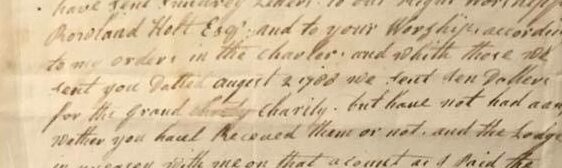
Prince Hall, like Phillis Wheatley, had certainly not failed to see the contradiction in the new United States of America: born out of an ideal of universal liberty yet countenancing human bondage.
As the founding document of the world’s first true experiment in representative government, the Declaration of Independence became the most famous expression of the principle of self-determination. Immediately and over centuries to come, it served as a lodestar for people around the globe. As the Declaration turns 250 years old, it is worth remembering that it has not only been an inspiration for the poor, the oppressed, those with their backs against the wall; they also helped inspire it and give it its enduring power.
The Declaration did not achieve its fame for having original ideas. On the contrary, its primary author, Thomas Jefferson, regarded it as a summation of “the harmonizing sentiments of the day,” the things everyone in the colonies was already thinking. John Adams, part of the committee charged with drafting the Declaration, later said, “there is not an idea in it but what had been hackneyed in Congress for two years before” and that the whole “essence of it” could have been found in a pamphlet published by Boston lawyer James Otis even before the Continental Congress first assembled.
But it was not only white statesmen and lawyers and pamphleteers who had been developing the ideas that were enshrined in the Declaration of Independence. Those ideas had been passing in conversation among ordinary folks, too. Samson Occom, a Mohegan preacher, received a letter in 1774 from Phillis Wheatley, an African-born woman enslaved in Boston, who declared, “In every human Breast, God has implanted a Principle, which we call Love of Freedom; it is impatient of Oppression, and pants for Deliverance.”
So far, Wheatley’s sentiments were ones the Continental Congress might well have uttered on behalf of all colonists. But she went on to say something else: “the same Principle lives in us”—those who, like her, were held in bondage. With polite yet pointed language, Wheatley called out the “strange Absurdity” in those “whose Words and Actions are so diametrically opposite”—the hypocrisy of white colonists clamoring for their rights of self-determination even as they deprived Black people of theirs.
Resentful colonists had been complaining for years that they were reduced to “slavery” by the British crown. The eminent British intellectual Samuel Johnson memorably lambasted this hypocrisy with his 1775 rhetorical question, “how is it that we hear the loudest yelps for liberty among the drivers of negroes?” But Wheatley had gotten there first. In her correspondence with Occom, from one excluded person to another, she contrasted “the Cry for Liberty” with the “Disposition for the exercise of oppressive Power over others”—enslaving fellow humans, that is. To see the contradiction between these, Wheatley wrote, “does not require the Penetration of a Philosopher.”
In leveling her critique this way, Wheatley wasn’t just being subtle. At a time when the philosophical currents of the Enlightenment were coursing through colonial taverns and town squares, coalescing into the “sentiments of the day” that Jefferson soon would set down in the Declaration of Independence, Wheatley was insisting that it wasn’t only philosophers who could grasp these ideas. It was ordinary people like her, too. In fact, people like her, who knew what it was like to be deprived of liberty, might actually understand them better, unalloyed with hypocrisy.
Wheatley’s belief that the yearning for freedom lived in “every human Breast” and had been “implanted” there by God anticipated some of the very language used in the Declaration: that people were “endowed by their creator” with a right to liberty, and that such truths were “self-evident.” It did not take a philosopher to see these truths. They were evident to everyone, and they applied to everyone.
People of African descent enslaved in North American clearly were talking about them. Once the colonies had officially made these ideas the basis for their political separation from Great Britain, Black writers and activists wasted no time in appealing to them as the authoritative expression of what they had long known. Six months after the signing of the Declaration in Philadelphia, a Black Bostonian named Prince Hall wrote a petition to the Massachusetts legislature, seeking freedom for himself and his compatriots.
Hall’s petition shows how thoroughly entwined were the rhetoric of the Declaration of Independence and his own convictions about American slavery. Jefferson had cited the colonists’ “patient sufferance” of English tyranny as a sign that they were not acting for only “light and transient causes”; Hall said that he and his fellows had “long and patiently waited,” in “imitation of the laudable example” of white colonists. Jefferson argued that governments “deriv[e] their just powers from the consent of the governed,” and Hall pointed out that enslaved Blacks had “never forfeited” their liberty “by any compact or agreement whatever.” The Declaration famously announced, “that all men are created equal, that they are endowed by their Creator with certain unalienable Rights, that among these are Life, Liberty and the pursuit of Happiness”; and Hall, harmonizing, wrote, “[we] have in common with all other men a natural and unalienable right to that freedom which the Great Parent of the Universe has bestowed equally on all mankind.”
Hall, like Wheatley, had certainly not failed to see the contradiction in the new United States of America: born out of an ideal of universal liberty yet countenancing human bondage. His petition—cannily, optimistically—offered the state legislature a way out of hypocrisy: put an end to slavery, Hall wrote, and the people of Massachusetts would be “no longer chargeable with the inconsistency of acting themselves the part which they condemn and oppose in others.”
It took Massachusetts seven more years to do so. It took the United States longer. But everyone, not just the philosophers, saw the Declaration’s promise, even—especially—those who did not initially share in it. They saw it, they set out after it, and they did not relent. Black literary activists like Phillis Wheatley and Prince Hall were helping to create the intellectual and political fervor of the Revolutionary era. Generations later, the United States still had not undone its tragic contradiction, and it led to civil war. Black writers then were still remaking, still striving to fulfill, the Declaration of Independence.

Christopher Hager is a writer who explores the lives of ordinary Americans through their writing—diaries kept by enslaved people, letters written by the wives and children of Civil War soldiers, magazine stories by factory workers.
His first book, Word by Word: Emancipation and the Act of Writing, won the 2014 Frederick Douglass Prize for the best book of the year on the subject of slavery. The research for his latest book, I Remain Yours: Common Lives in Civil War Letters, was supported by a Public Scholar award from the National Endowment for the Humanities.
Hager is the Hobart Professor of the Humanities at Trinity College and lives with his wife and two children in northwestern Connecticut.
Chris Hager contributed historical scholarship to the 6,000+ Declarations of Independence exhibit, featuring artwork developed from original sketches by Hartford artist Joe Young. This exhibit is on view in the Stowe Visitors Center from June through December 2026. The development of this exhibit was made possible by the America250 Creation of New Work Grant from the Roberts Foundation for the Arts and is presented by the Roberts Foundation for the Arts and the Travelers Arts Impact Grant. Our America250CT celebration July 4 is made possible in part by CT Humanities.