
It was so clearly impossible to square the practice of human bondage with “life, liberty, and the pursuit of happiness” that defenders of slavery didn’t even try. . . . The Declaration remained a living, meaningful part of U.S. political culture—what Lincoln had called “a stumbling-block to all those who in after times might seek to turn a free people back into the hateful paths of despotism”—because Americans on the margins persisted in laying claim to it. And in laying claim to it, they kept it vital.
During the era of the American Revolution, the Declaration of Independence inspired many people who were practically excluded from its lofty claims. Black Americans like Prince Hall borrowed the Declaration’s language in petitioning for an end to slavery in Massachusetts. An enslaved woman named Elizabeth Freeman went to court and won a suit for her own freedom in 1781. Fired by the ideals that “all men are created equal,” northern states adopted measures of gradual abolition, and one of the signal acts of the early U.S. Congress, in 1787, was to forbid slavery in the vast swath of unorganized federal territory that ultimately became Ohio, Indiana, Illinois, Michigan, and Wisconsin.
But as the tumultuous era of the revolution calmed, the new nation stabilized into a free north and a slave south. These increasingly polarized sections seemed to disagree on nearly everything—including the Declaration of Independence. It was so clearly impossible to square the practice of human bondage with “life, liberty, and the pursuit of happiness” that defenders of slavery didn’t even try.
Instead, they sought to invalidate the Declaration itself. They pointed out that only the Constitution had the force of law and dismissed the Declaration as a flight of Thomas Jefferson’s philosophical fancy, nothing of political import. By 1854, a pro-slavery legislator, John Pettit, speaking on the floor of the U.S. Senate, declared the notion that all men are created equal “a self-evident lie.” Even in 1863, after Abraham Lincoln drew upon the Declaration of Independence in his Gettysburg Address (“four score and seven years” was the distance from 1776, not from the ratification of the Constitution), one Chicago newspaper accused Lincoln of bald misrepresentation when he said the nation was “dedicated to the proposition that all men are created equal.” In truth, this editorial claimed, the American founders had “too much self-respect to declare that negroes were their equals, or were entitled to equal privileges.”
White supremacy in America, in short, recognized the Declaration of Independence as its enemy, and opponents of racial equality took pains to deny that the United States or anyone in it was bound by that document. “All men are created equal” might have gone down to the disparagements of its southern detractors (just as it still could go down today to counter-claims cloaked in terms of merit, or rhetoric that dehumanizes people for their identity or national origin). The reason it didn’t is not just that the Civil War was won, or that Lincoln gave the Gettysburg Address (after all, that speech was not yet regarded as a succinct expression of an American creed). Rather, the Declaration remained a living, meaningful part of U.S. political culture—what Lincoln had called “a stumbling-block to all those who in after times might seek to turn a free people back into the hateful paths of despotism”—because Americans on the margins persisted in laying claim to it. And in laying claim to it, they kept it vital.
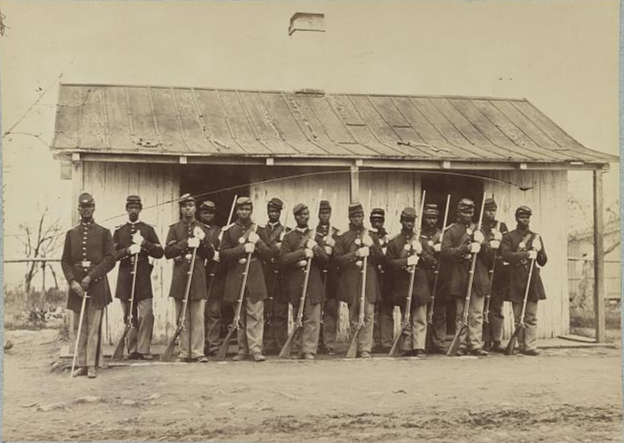
The Declaration’s language of “unalienable rights” took on new resonance during the second half of the Civil War, when Black men were at last allowed to enlist in the U.S. army. Military service as a basis for citizenship dates back to ancient Greece and Rome, and Black leaders in America saw in it an opportunity to advance the cause of civil rights. Frederick Douglass worked tirelessly to recruit northern Black men for federal regiments. “Once let the black man get upon his person the brass letters US,” Douglass said, referring to the accessories of a blue Union army uniform; “let him get an eagle on his button, and a musket on his shoulder, and bullets in his pocket, and there is no power on earth or under the earth which can deny that he has earned the right of citizenship in the United States.”
The 180,000 Black men who donned that uniform not only earned those rights; they quickly began to exercise them. Black soldiers were subjected to harsh and unequal treatment in the military, paid less than white soldiers, prohibited from becoming officers, and often assigned to the worst positions and forms of labor. But they also believed that the U.S. government was now their government, and they had a right to petition it for redress of their grievances, a right to protest—just as the revolutionaries of 1776 had protested the injustices of the British crown.
Men of the famous 54th Massachusetts Regiment (dramatized in the 1989 film Glory) banded together to refuse their army paychecks until they should receive the same amounts as white soldiers. Soldiers wrote letters directly to President Lincoln demanding to be “justly dealt with.” Even men who had only recently escaped slavery and never been educated, after they joined up with forces in the South, quickly learned the rudiments of literacy and put them to use in asserting their rights. A man named Prince Murrell in Alabama—who had clearly heard the Declaration of Independence, even if he had never read it—wrote to a general to complain of unequal treatment and, after detailing the deplorable conditions for his regiment, said, “This is not the persuit of happa ness.”
For Black men during the Civil War, the “spirit of ‘76” was undeniably alive. The rallying cry of the revolution, “Give me liberty or give me death,” had a meaning now for them that it no longer had for white Americans. As a recruiting poster for Black regiments put it, “Let us rather die freemen than live to be slaves.” It was what Harriet Beecher Stowe had imagined in Uncle Tom’s Cabin for her character George Harris, who flees from slavery in Kentucky and vows never to be recaptured: “I’ll fight for my liberty to the last breath I breathe. You say your fathers did it; if it was right for them, it is right for me!”
—
 Christopher Hager is a writer who explores the lives of ordinary Americans through their writing—diaries kept by enslaved people, letters written by the wives and children of Civil War soldiers, magazine stories by factory workers.
His first book, Word by Word: Emancipation and the Act of Writing, won the 2014 Frederick Douglass Prize for the best book of the year on the subject of slavery. The research for his latest book, I Remain Yours: Common Lives in Civil War Letters, was supported by a Public Scholar award from the National Endowment for the Humanities.
Hager is the Hobart Professor of the Humanities at Trinity College and lives with his wife and two children in northwestern Connecticut.
Chris Hager contributed historical scholarship to the 6,000+ Declarations of Independence exhibit, featuring artwork developed from original sketches by Hartford artist Joe Young. This exhibit is on view in the Stowe Visitors Center from June through December 2026. The development of this exhibit was made possible by the America250 Creation of New Work Grant from the Roberts Foundation for the Arts and is presented by the Roberts Foundation for the Arts and the Travelers Arts Impact Grant. Our America250CT celebration July 4 is made possible in part by CT Humanities.