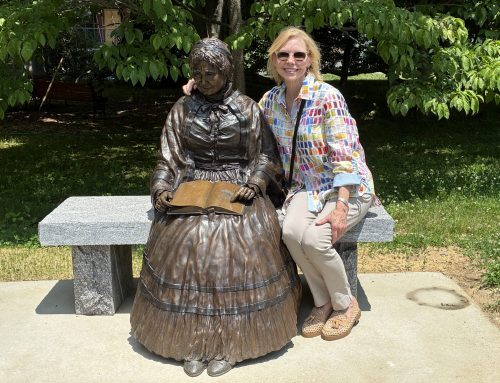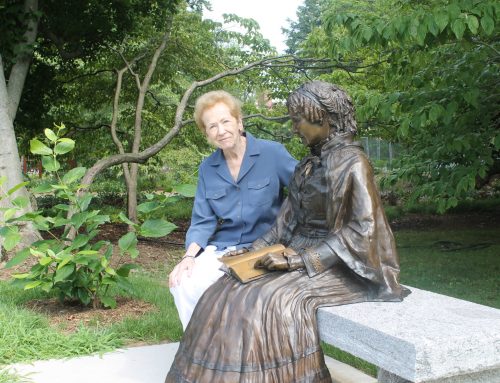

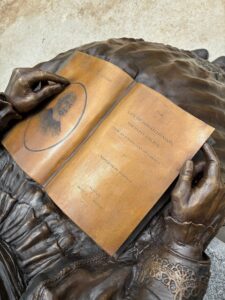
A beautiful new bronze statue with intricate detail sits on the path from our visitor center to Harriet Beecher Stowe’s home. The seated figure depicts Harriet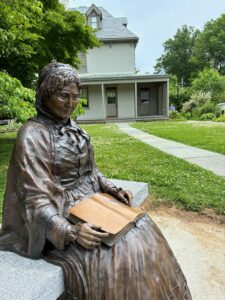 Beecher Stowe with her head inclined to a book cradled in her lap. Her finger points to the title page: The Life of Josiah Henson, Formerly a Slave, Now an Inhabitant of Canada, as Narrated by Himself (1849).
The statue, sculpted by Brenda Councill, is a gift from Stowe’s great great granddaughter Rosamond Warren Allen, and it was installed June 12, 2026, two days before Stowe’s 115th birthday.
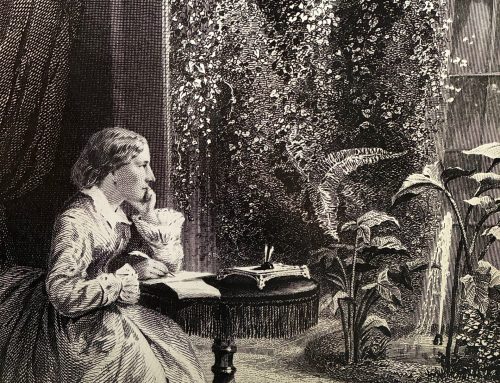
The statue honors the remarkable woman who wrote the novel that galvanized the anti-slavery movement in both America and the world, Uncle Tom’s Cabin (1852). With this book—an act of literary activism—Stowe (1811-1896) changed hearts and minds worldwide concerning the humanity of Black people.
 Many vocal pro-slavery readers cast doubt about the authenticity of what Stowe wrote, saying the story was too brutal and too filled with pathos to be true. They also questioned how a northern white woman speak with any authority about the South.
To prove that she did her homework, so to speak, Stowe compiled a unique book she titled: A Key to Uncle Tom’s Cabin Presenting the Original Facts and Documents Upon Which the Story Is Founded, Together with Corroborative Statements Verifying the Truth of the Work. (1853) In this volume, she gives credit to those whose work she utilized for her novel—the real, lived experiences that informed her fiction.
In Chapter VI of A Key, Stowe talks about several enslaved men whose life stories contributed to the fictional Tom. Among these is Josiah Henson, who she wrote about at length, focusing primarily on his devotion to Christianity, which Stowe admired and respected.
Josiah Henson not only freed himself and his family by escaping enslavement in Kentucky to relocate in Canada, he also returned to the United States to free another 118 enslaved people, bringing them to Dresden, Ontario, to build new homes and forge community in the Dawn Settlement, which he founded.
Stowe and Henson met once, and they cooperated to help promote their cause—ending slavery. Stowe wrote the introduction to Father Henson’s Story of His Own Life (1858) and Henson’s speaking tours were billed as presentations from the original Uncle Tom.
We found two transcription of letters from Stowe about Henson:
HARRIET BEECHER STOWE to WILLIAM H. GILLEY, 15 MAY 1876
“May 15, 1876
Rev Wm H. Gilley
I take pleasure in endorsing with all my heart that noble man, Josiah Henson, to be worthy of all the aid and help which any good man may be disposed to give. It is also true that a sketch of his life, published many years ago by the Anti-Slavery Society of Massachusetts, furnished me many of the finest conceptions and incidents of Uncle Tom’s character, in particular the scene where he refuses to free himself by the murder of a brutal master.
The real history of Josiah Henson in some points goes even beyond that of Uncle Tom in his heroic manhood. He once visited me in Andover, and personal intercourse confirmed my high esteem I had for him. I heartily hope he may have friends to assist him in his difficulties. Yours very truly,
H.B. Stowe”
[Letter printed in Brion Gyson. To Master — A Long Goodnight.} (NY 1946), page 47.]
HARRIET BEECHER STOWE to the INDIANAPOLIS TIMES, 27 JULY 1882
“Ferry Park Hotel Saco, July 27, 1882
Dear Sir —
In reply to your inquiries, I will say that the character of “Uncle Tom” was not the biography of any one man. The first suggestion of it came to me while in Walnut Hills, O., I wrote letters for my colored cook to her husband, a slave in Kentucky. She told me that he was so faithful his master trusted him to come alone and unwatched to Cincinnati to market his farm produce. Now this, according to the laws of Ohio, gave the man his freedom, since if any master brought or sent his slave into Ohio he became free, de facto. But she said her husband had give his word as a Christian to his master that he would not take advantage of the law — his master promising him his freedom. Whether he ever got it or not I know not.
It was some four or five years after, when the fugitive slave law made me desirous of showing what slavery was, that I conceived the plan of writing the history of a faithful Christian slave. After I had begun the story I got, at the anti-slavery rooms in Boston, the autobiography of Josiah Henson, and introduced some of its most striking incidents into my story. The good people of England gave my simple, good friend Josiah enthusiastic welcomes as the Uncle Tom of the story, though he was alive and well and likely long to live, and the Uncle Tom of the story was buried in a martyr’s grave. So much in reply to your inquiries. I trust this plain statement may prevent my answering any more letters on this subject. Truly yours,
- B. Stowe”
[Letter printed in the Indianapolis Times, 3 August 1882, p. 2.]
At the Stowe Center we explore the legacy of Harriet Beecher Stowe and all who advocate hope and freedom then and now. For this reason, we chose to show Stowe in one of her most powerful stances—reading!
Reading is one of the most effective ways to see the world from the point of view of someone other than yourself. Reading builds empathy, allowing the reader to understand why a person/character makes the decisions they make. Seeing the world from a perspective other than your own invites each and all of us to consider what would be a better world not just for me, but for us.
The new Harriet Beecher Stowe statue at the Stowe Center is only the second full size statue dedicated to Stowe—and it is a tribute that speaks to the remarkable, powerful, inspiring act of reading to gain transformative knowledge.