
Precedented Times
“I trust that it will be in your heart to do all that you can for him”
In 1852, Harriet Beecher Stowe wrote to friends urging them to support the Reverend Thomas Strother, an enslaved man under threat of being sold by creditors to cover the debts of his enslaver, then deceased.
Reverend Strother was enslaved by a St. Louis merchant who died in 1850 deeply in debt. His estate was taken by creditors who were selling it off. Reverend Strother, his wife, and his daughter were part of this estate. Throughout 1851 and ‘52, Reverend Strother travelled the country trying to raise $1,600, an incredible amount of money at the time, to purchase the freedom of his wife, daughter, and himself. Additionally, Reverend Strother had to pay the creditors, now the de facto enslavers, $10 a month in order to be able to leave to raise the funds. His wife and daughter remained in St. Louis.
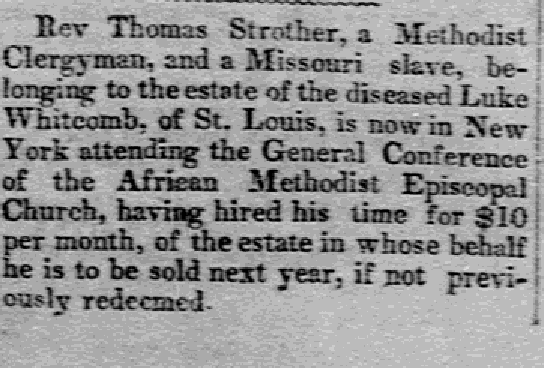
Newspaper section accounting Rev. Thomas Strother’s travels
In the spring of 1852, Reverend Strother attended the African Methodist Convention in New York City, where he met Harriet Beecher Stowe and her brother, Henry Ward Beecher, who each wrote letters of introduction for Reverend Strother. Stowe and Beecher were arguably two of the most well-known people in America at this time and their letters and introductions certainly helped raise financial support for Reverend Strother. By August of 1852, Reverend Strother had raised $1,350, enough to purchase the freedom of his wife and daughter, as well as part of the money required for his own freedom. He needed to raise the final $250 by September, the deadline creditors had given him, for his own freedom or be sold to another enslaver.
Stowe’s letter is brief and to the point. She wrote:
Dear Madam,
The bearer is a minister- a delegate to the African Methodist Convention now in session in this city and bears satisfactory credentials of his character and standing.
He is a slave and unless he can raise money this summer for his ransom must be sold to settle an insolvent estate.
The rest of his history will be unfolded by himself
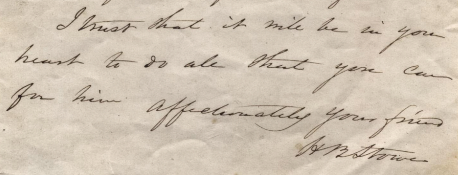
I trust that it will be in your heart to do all that you can for him
Affectionately your friend
HB Stowe
Four sentences concerning the life of one man, who will tell his own story. The social and political context of this letter, and the materiality of the letter, however, reveal a much broader history.
In 1850, the Fugitive Slave Act was updated as part of the Compromise of 1850. This updated act required that anyone fleeing slavery, or anyone accused or suspected of fleeing slavery, be captured. This law applied even to free states and mandated that everyone assist in the kidnapping and capture of Black people. The kidnapped people were not allowed to testify on their own behalf and anyone found aiding people who were fleeing faced imprisonment up to 6 months and fines up to $1,000.
There was an incentive to kidnap as many people as possible. If a kidnapped person was found to be escaped, the reward was $10 to the kidnapper. If a kidnapped person was found not to be escaped, the reward was $5 to the kidnapper. Even if the person should never have been taken, the person who did so received $5. This was the law and this was terror. This was power without accountability. No Black person in any state in the United States could be assured freedom from abduction, injury, or enslavement.
The practical result of this was that bands of state-sanctioned patrollers hunted people and kidnapped those who they could accuse of being guilty and the perceived race of someone was in some cases enough to make an accusation.
Reverend Strother, an enslaved man traveling in 1852, was at incredible risk, despite being “allowed” this movement by the creditors. Even in the free states of New England, he faced the very real threat of being taken.
Which brings me to Stowe’s letter itself. The letter, written over 170 years ago, is in exceptionally good condition. The full paper measures 9 ½” x 7 ¼”, folded in half to 4 ¾” x 7 ¼”, with the body of the letter on one half and the address on the other. The half has then been folded in thirds, keeping the address on the outside. As a letter of introduction, this wasn’t mailed; it was meant to be carried by a person and shown or given to another as a way of identifying and introducing oneself. The paper has no tears, it is not overly wrinkled or crumpled, the writing is still clear. This letter has been cared for. And when we think of the circumstances around this letter, we understand why.
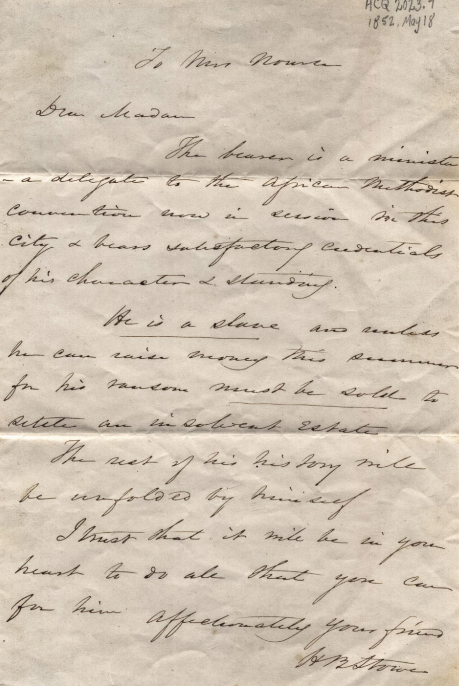
HBS letter of introduction for Rev. Thomas Strother
This letter, while identifying Reverend Strother as an enslaved man, attests to his given permission to move throughout the country. Additionally, it shows his connection to one of the most well-known people in the world, as Stowe was. Reverend Strother knew that this was one of the documents that he had to carry to keep safe, that he could show to patrollers and other officials, should he need to, to prove his right to be in Massachusetts, in Maine, and elsewhere.
The 1850 Fugitive Salve Act changed the stakes for Black Americans, both free and enslaved. Terror swept through communities. It changed the way people moved through the country and their communities; it dictated the items people carried; and it robbed people of a sense of liberty. And it galvanized people against slavery. No longer could white Northerners feel that slavery was a Southern problem. When their neighbors and community members were taken, slavery was not only something that happened in other places. It was undeniably an American problem.
It would take 10 years after the passing of the 1850 Compromise for the country to go to war over slavery and another 5 years for that war to end, officially, if not always in practice, ending the period of chattel slavery in the United States. We do not yet know what happened to Reverend Strother during this period. We do not yet know if he was able to raise the final $250 the creditors demanded of him. We know that he survived the war and lived in Cairo, Illinois in 1868 where he was a prominent member of the Black community in Cairo, advocating for the rights of Black Americans.
This history is being suppressed. Schools, libraries, and national parks and historic sites are being forced to remove mention of this country’s history related to slavery. We must ask why this history is being suppressed. And we must ask ourselves what is at stake if we don’t know this history.